Specifying rotations or origin shifts in Potential classes#
Most of the gravitational potential classes implemented in gala support
shifting the origin of the potential relative to the coordinate system, and
specifying a rotation of the potential relative to the coordinate system.
By default, the origin is assumed to be at (0,0,0) or (0,0), and there is no
rotation assumed.
For the examples below the following imports have already been executed:
>>> import astropy.units as u
>>> import numpy as np
>>> import gala.potential as gp
>>> from gala.units import galactic, solarsystem
Origin shifts#
For potential classes that support these options, origin shifts are specified by
passing in a Quantity to set the origin of the potential in the
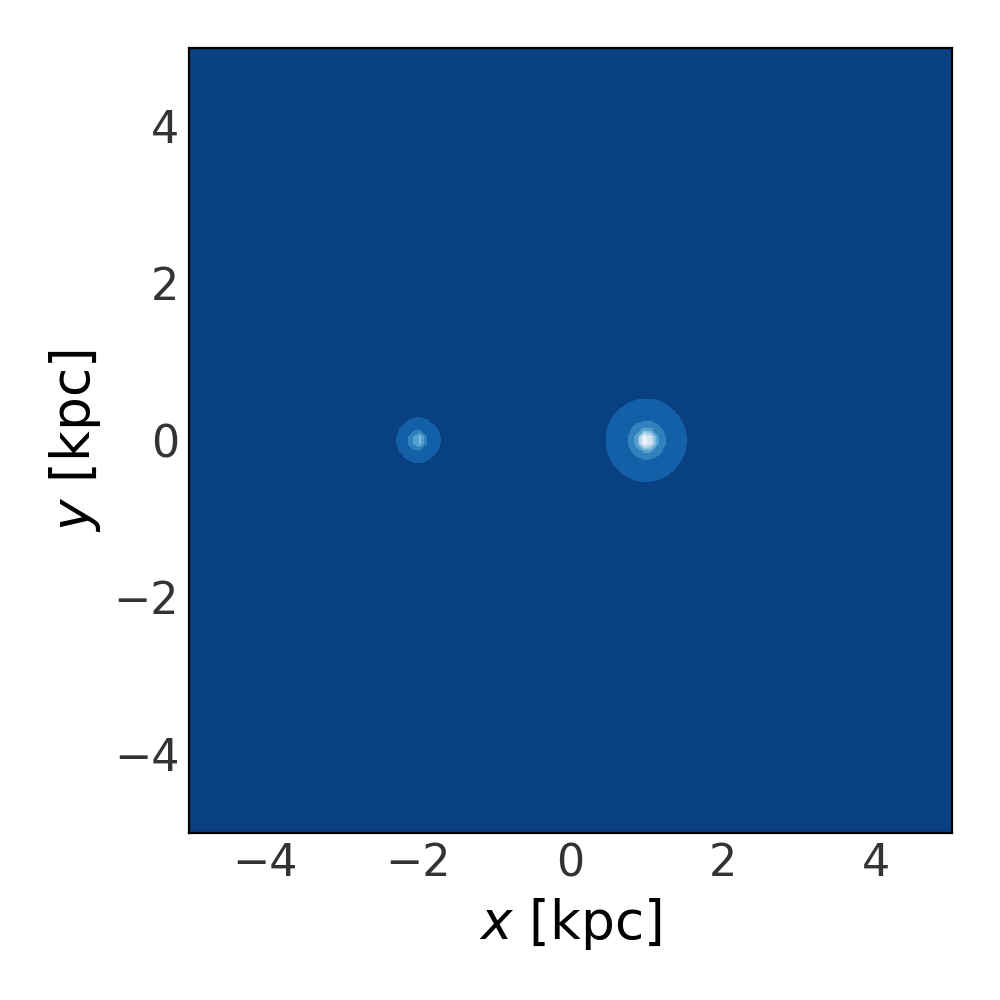
given coordinate system. For example, if we are working with two
KeplerPotential objects, and we want them to be offset from
one another such that one potential is at (1, 0, 0) AU and the other is at
(-2, 0, 0) AU, we would define the two objects as:
>>> p1 = gp.KeplerPotential(m=1*u.Msun, origin=[1, 0, 0]*u.au,
...                         units=solarsystem)
>>> p2 = gp.KeplerPotential(m=0.5*u.Msun, origin=[-2, 0, 0]*u.au,
...                         units=solarsystem)
To see that these are shifted from the coordinate system origin, let’s combine
these two objects into a CCompositePotential and
visualize the potential:
>>> pot = gp.CCompositePotential(p1=p1, p2=p2)
>>> fig, ax = plt.subplots(1, 1, figsize=(5, 5))
>>> grid = np.linspace(-5, 5, 100)
>>> p.plot_contours(grid=(grid, grid, 0.), ax=ax)
>>> ax.set_xlabel("$x$ [kpc]")
>>> ax.set_ylabel("$y$ [kpc]")
(Source code, png, pdf)
Rotations#
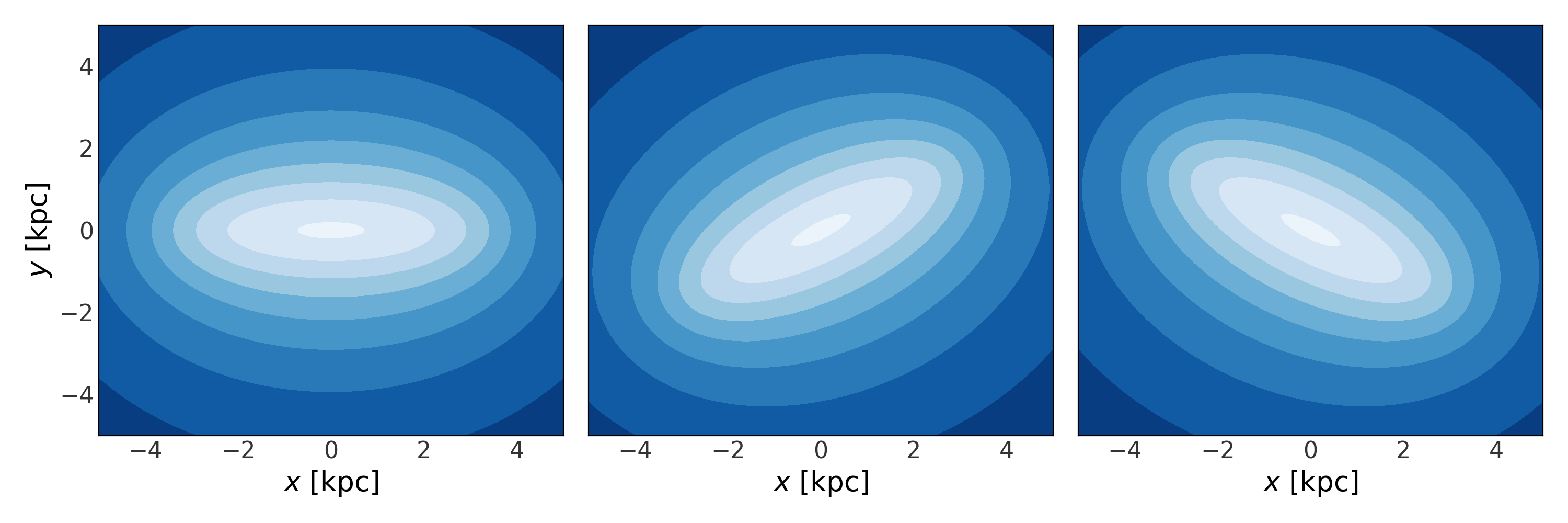
Rotations can be specified either by passing in a
scipy.spatial.transform.Rotation instance, or by passing in a 2D numpy array
specifying a rotation matrix. For example, let’s see what happens if we rotate a
bar potential using these two possible inputs. First, we’ll define a rotation
matrix specifying a 30 degree rotation around the z axis (i.e.
counter-clockwise) using astropy.coordinates.matrix_utilities.rotation_matrix.
Next, we’ll define a rotation using a scipy
Rotation object:
>>> from astropy.coordinates.matrix_utilities import rotation_matrix
>>> from scipy.spatial.transform import Rotation
>>> R_arr = rotation_matrix(30*u.deg, 'z')
>>> R_scipy = Rotation.from_euler('z', 30, degrees=True)
Warning
Note that astropy and scipy have different rotation conventions, so even though both of the above look like identical 30 degree rotations around the z axis, they result in different (i.e. transposed or inverse) rotation matrices:
>>> R_arr
array([[ 0.8660254,  0.5      ,  0.       ],
       [-0.5      ,  0.8660254,  0.       ],
       [ 0.       ,  0.       ,  1.       ]])
>>> R_scipy.as_matrix()
array([[ 0.8660254, -0.5      ,  0.       ],
       [ 0.5      ,  0.8660254,  0.       ],
       [ 0.       ,  0.       ,  1.       ]])
Let’s see what happens to the bar potential when we specify these rotations:
>>> bar1 = gp.LongMuraliBarPotential(m=1e10, a=3.5, b=0.5, c=0.5,
...                                  units=galactic)
>>> bar2 = gp.LongMuraliBarPotential(m=1e10, a=3.5, b=0.5, c=0.5,
...                                  units=galactic, R=R_arr)
>>> bar3 = gp.LongMuraliBarPotential(m=1e10, a=3.5, b=0.5, c=0.5,
...                                  units=galactic, R=R_scipy)
(Source code, png, pdf)