Getting Started#
Welcome to the gala documentation!
For practical reasons, this documentation generally assumes that you are
familiar with the Python programming language, including numerical and
computational libraries like numpy, scipy, and matplotlib. If you need a refresher on Python programming, we
recommend starting with the official Python tutorial, but many other good resources are
available on the internet, such as tutorials and lectures specifically designed
for using Python for scientific applications.
On this introductory page, we will demonstrate a few common use cases for gala
and give an overview of the package functionality. For the examples
below, we will assume that the following imports have already been executed
because these packages will be generally required:
>>> import astropy.units as u
>>> import numpy as np
Computing your first stellar orbit#
One of the most common use cases for gala is to compute an orbit for a star
within a mass model for the Milky Way. To do this, we need to specify two
things: (1) the model of the Milky Way that we would like to use to represent
the mass distribution, and (2) the initial conditions of the star’s orbit.
Mass models in gala are specified using Python classes that represent
standard gravitational potential models. For example, most of the standard,
parametrized gravitational potential models introduced in [BT08]
are available as classes in the gala.potential module. The standard Milky
Way model recommended for use in gala is the
MilkyWayPotential, which is a pre-defined,
multi-component mass model with parameters set to fiducial values that match the
rotation curve of the Galactic disk and the mass profile of the dark matter
halo. We can create an instance of this model with the fiducial parameters by
instantiating the MilkyWayPotential class without
any input:
>>> import gala.potential as gp
>>> mw = gp.MilkyWayPotential()
>>> mw
<CompositePotential disk,bulge,nucleus,halo>
This model, by default, contains four distinct potential components as listed in
the output above: disk, bulge, nucleus, and halo components. You can configure
any of the parameters of these components, or create your own “composite”
potential model using other potential models defined in gala.potential,
but for now we will use the fiducial model as we defined it, the variable
mw.
All of the gala.potential class instances have a set of standard methods
that enable fast calculations of computed or derived quantities. For example,
we could compute the potential energy or the acceleration at a Cartesian
position near the Sun:
>>> xyz = [-8., 0, 0] * u.kpc
>>> mw.energy(xyz)
<Quantity [-0.16440296] kpc2 / Myr2>
>>> mw.acceleration(xyz)
<Quantity [[ 0.00702262],
           [-0.        ],
           [-0.        ]] kpc / Myr2>
The values that are returned by most methods in gala are provided as Astropy
Quantity objects, which represent numerical data with
associated physical units. Quantity objects can be
re-represented in any equivalent units, so, for example, we could display the
energy or acceleration in other units:
>>> E = mw.energy(xyz)
>>> E.to((u.km/u.s)**2)
<Quantity [-157181.98979398] km2 / s2>
>>> acc = mw.acceleration(xyz)
>>> acc.to(u.km/u.s / u.Myr)
<Quantity [[ 6.86666358],
           [-0.        ],
           [-0.        ]] km / (Myr s)>
Now that we have a potential model, if we want to compute an orbit, we need to
specify a set of initial conditions to initialize the numerical orbit
integration. In gala, initial conditions and other positions in phase-space
(locations in position and velocity space) are defined using the
PhaseSpacePosition class. This class allows a number of
possible inputs, but one of the most common inputs are Cartesian position and
velocity vectors. As an example orbit, we will use a position and velocity that
is close to the Sun’s Galactocentric position and velocity:
>>> import gala.dynamics as gd
>>> w0 = gd.PhaseSpacePosition(pos=[-8.1, 0, 0.02] * u.kpc,
...                            vel=[13, 245, 8.] * u.km/u.s)
By convention, I typically use the variable w to represent phase-space
positions, so here w0 is meant to imply “initial conditions.” Note that,
when passing in Cartesian position and velocity values, we typically have to
pass them in as Quantity objects (i.e., with units). This is
required whenever the potential class you are using has a unit system, which you
can check by calling the units
attribute of your potential object:
>>> mw.units
<UnitSystem (kpc, Myr, solMass, rad)>
Here, our Milky Way potential model has a unit system with dimensional units.
Note that we could have used any length unit for the position and any velocity
unit for the velocity, because gala handles the unit conversions internally.
Now with a potential model defined and a set of initial conditions, we are set
to compute an orbit! To do this, we use the numerical integration system defined
in gala.integrate, but do so using the convenience interface available on any
Potential object through the
integrate_orbit() method:
>>> orbit = mw.integrate_orbit(w0, dt=1*u.Myr, t1=0, t2=2*u.Gyr)
By default, this method uses Leapfrog integration , which is a fast, symplectic
integration scheme. The returned object is an instance of the
Orbit class, which is similar to the
PhaseSpacePosition but represents a collection of phase-space
positions at times:
>>> orbit
<Orbit cartesian, dim=3, shape=(2000,)>
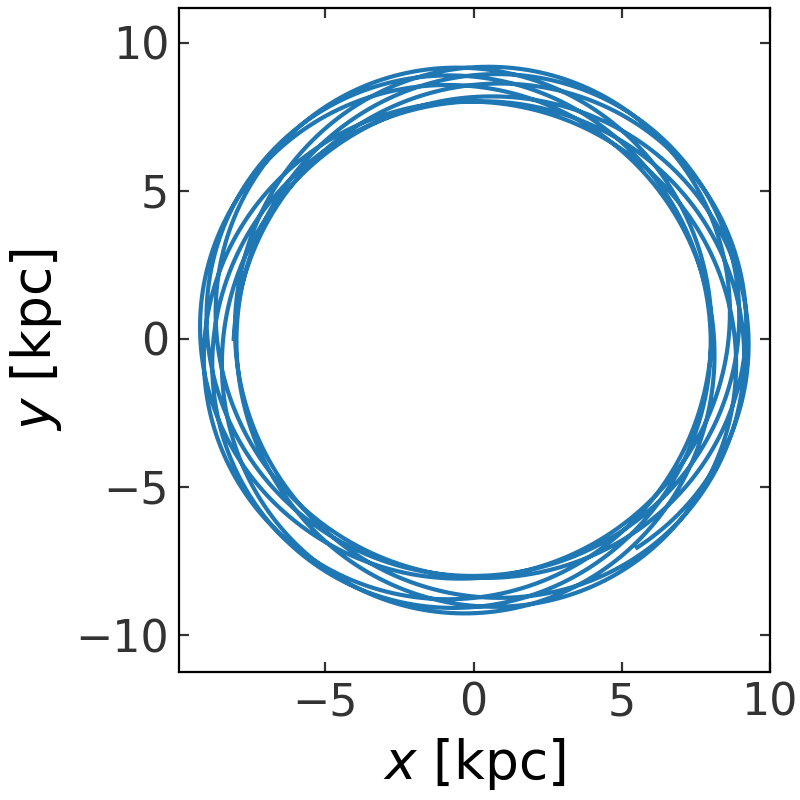
Orbit objects have many of their own useful methods for
performing common tasks, like plotting an orbit:
>>> orbit.plot(['x', 'y'])
(Source code, png, pdf)

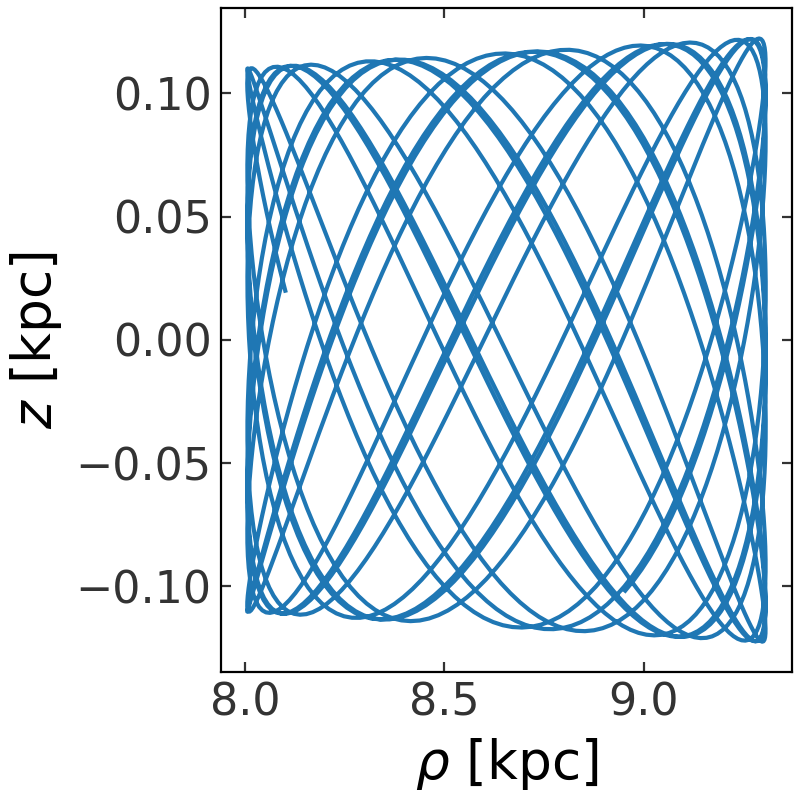
Orbit objects by default assume and use Cartesian coordinate
representations, but these can also be transformed into other representations,
like Cylindrical coordinates. For example, we could re-represent the orbit in
cylindrical coordinates and then plot the orbit in the “meridional plane”:
>>> fig = orbit.cylindrical.plot(['rho', 'z'])
(Source code, png, pdf)

Or estimate the pericenter, apocenter, and eccentricity of the orbit:
>>> orbit.pericenter()
<Quantity 8.00498069 kpc>
>>> orbit.apocenter()
<Quantity 9.30721946 kpc>
>>> orbit.eccentricity()
<Quantity 0.07522087>
gala.potential Potential objects and Orbit objects have
many more possibilities, so please do check out the narrative documentation for
gala.potential and gala.dynamics if you would like to learn more!
What else can gala do?#
This page is meant to demonstrate a few initial things you may want to do with
gala. There is much more functionality that you can discover either through
the tutorials or by perusing the user guide. Some other commonly-used functionality includes:
Where to go from here#
The two places to learn more are the tutorials and the user guide:
The Tutorials are narrative demonstrations of functionality that walk through simplified, real-world use cases for the tools available in
gala.The User Guide contains more exhaustive descriptions of all of the functions and classes available in
gala, and should be treated more like reference material.
Bibliography#
- BT08
J. Binney and S. Tremaine. Galactic Dynamics: Second Edition. Princeton Series in Astrophysics. Princeton University Press, 2008. ISBN 9781400828722. URL: https://ui.adsabs.harvard.edu/abs/2008gady.book.....B.